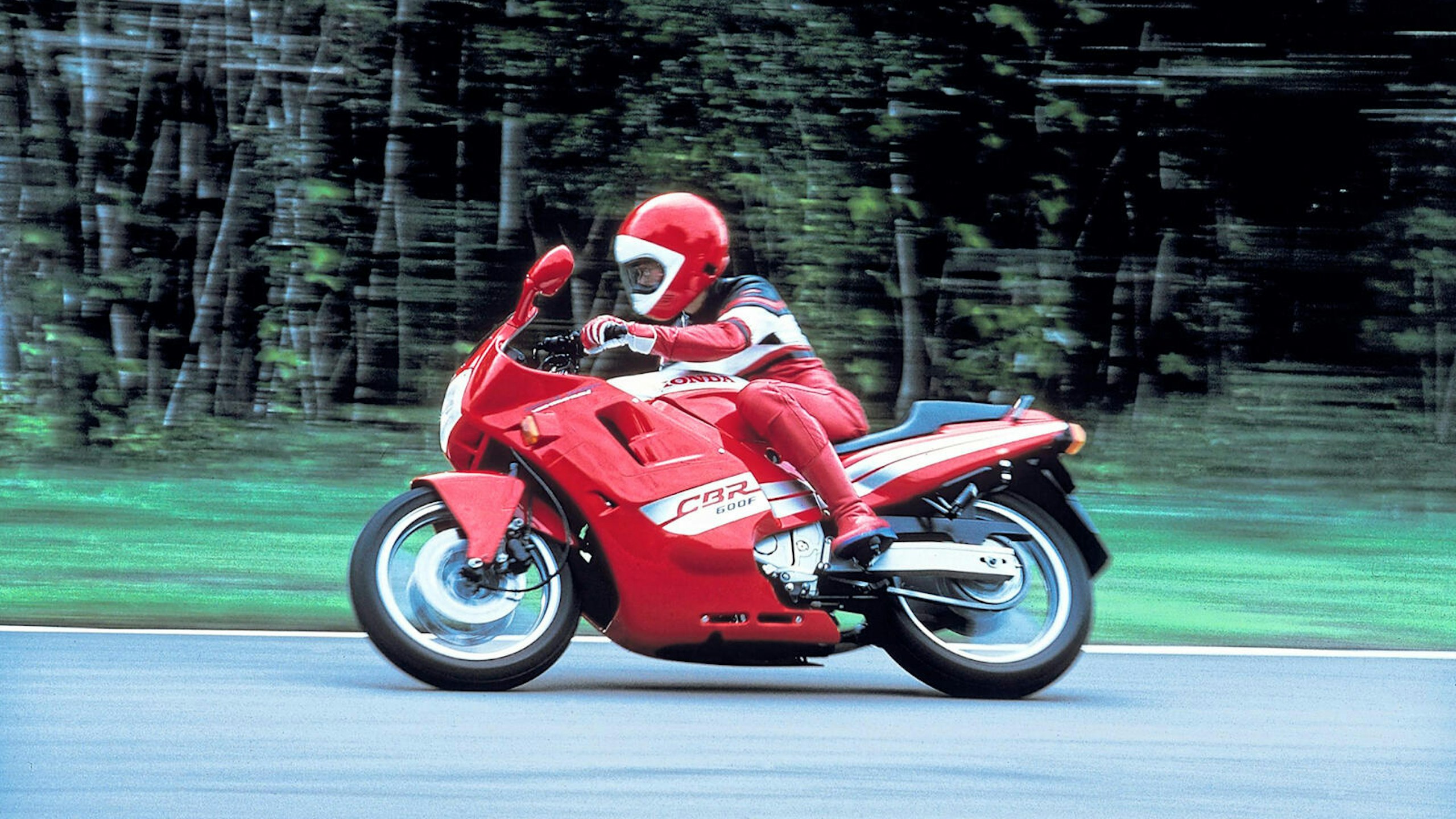
If you threw a knee slider into a bike park in 1995, chances are it’d have hit a CBR600F. It was Britain’s biking bullseye for the first half of the 1990s, winning club, national and international races, outselling every other bike and wooing a generation of riders. Yet it was built around a humble engine and modest steel-framed chassis that was anything but ahead of its time. Rivals all boasted superior performance, spec and tech.
’Twas not always thus. When the CBR arrived in December 1986, it was radical. The 600cc class only included Kawasaki’s GPZ600R, also a 16-valve water-cooled inline four. But the Honda aced it with a shorter stroke, wider bores, larger valves, higher revs and more power and torque, peaking at 84bhp and 44lb·ft. The CBR was also the first middleweight with sweet‑spot 17in wheels (instead of the usual 16in/18in combo), and the first to tilt the motor forward (by 35°) to straighten intake paths and lower the centre of gravity.
But it was the 600’s voluptuous bodywork that took it from merely contemporary to openly futuristic. It was fully encased in seamless, curvaceous plastic, with a shrouded front mudguard reaching down to the axle, a single-piece fairing swooping from headlight to belly pan, infills between tank and fairing hiding the frame, a single-section tailpiece wrapping round the light, and a huge rear hugger encasing the top third of the rear wheel. Teardrop mirrors were on winglet-style stems, and front indicators were faired-in. It looked like science fiction to some. MCN’s road tester, the late Jim Lindsay, was at the launch in Japan. ‘When we saw it, first thing we thought was how ugly it was,’ he recalled in 2014. ‘My first impression was: “Oh my god, it’s hideous!”. It was instantly nicknamed the Jellymould.’
The CBR’s project leader, Minoru Morioka, had been inspired by Massimo Tamburini’s 1986 Ducati Paso 750 and Federico Martini’s 1985 Bimota DB1 (both fully faired) – like them, he felt aero was more important to performance than saving weight through costly, exotic materials alone (hence the steel frame).
‘Honda certainly made a song and dance about aerodynamics, saying the CBR had less drag than the class-leading Citroën DX,’ remembered Lindsay. ‘But either way once you got it going it was outstanding. Stable, all the power you wanted, and was actually a very good bike all round – not just a sportsbike. So, having initially thought “bloody hell, what deranged idiot designed that?”, it was a better bike than the GPZ600R.’
Literally ahead of the curve, then.