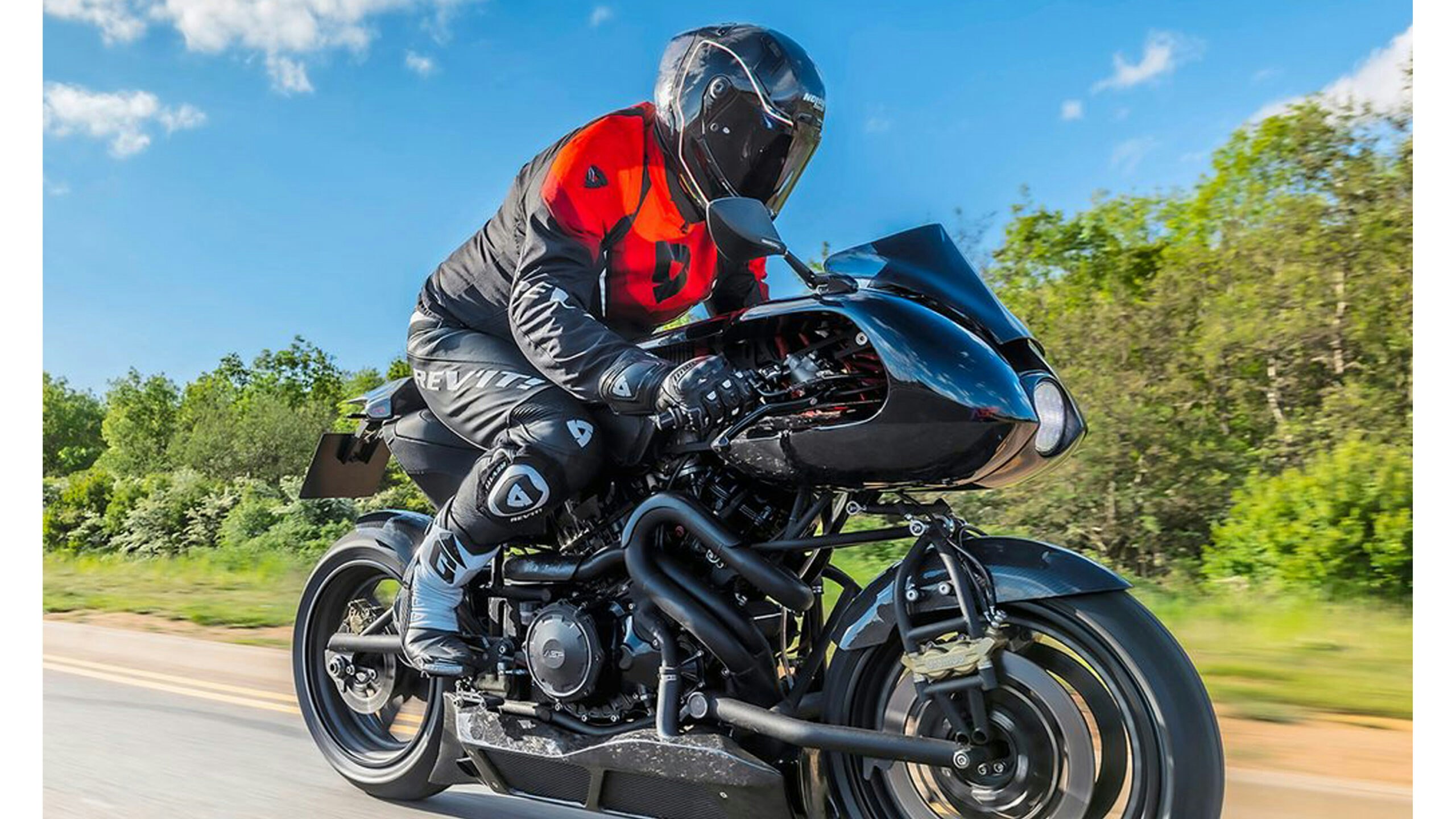
ASP4 test
Litre-bike power, 250cc dimensions, no forks – and all homemade. Bike gets an exclusive ride on the ASP4, one man’s 35-year quest to do things differently…
By Jim Moore Photography Jason Critchell
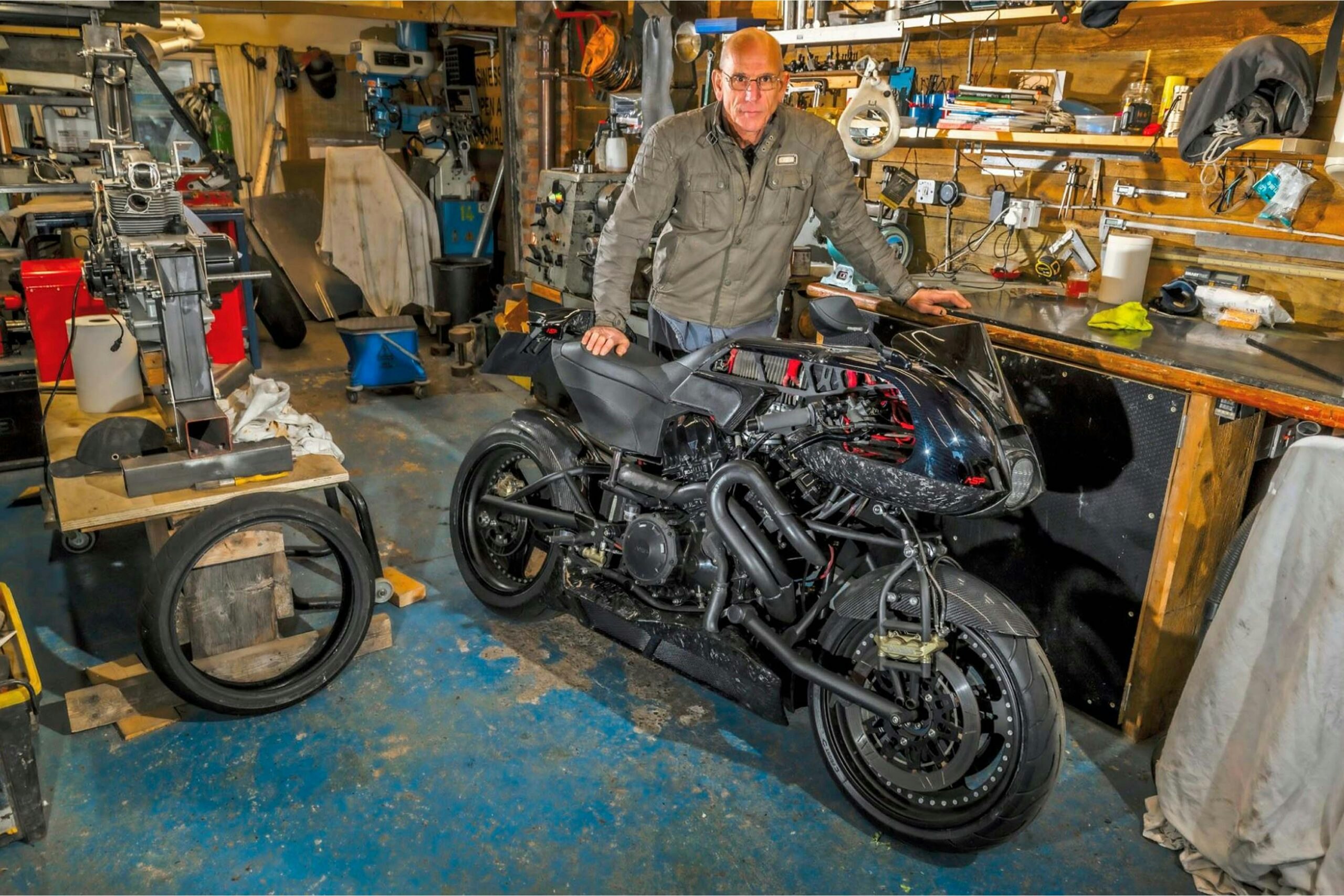
Andy Stevenson leans back against the lathe in his workshop. ‘I’ve always done my own thing,’ he deadpans. ‘When everyone else was riding two-strokes, I had a Ducati. Then when Ducatis got popular, I moved on to other things.’
He’s not kidding. By ‘other things’ Andy doesn’t mean another genre or brand of bike – he built his own. From scratch. That was 35 years ago. Since then he’s created three more machines in his Nottinghamshire garage, almost entirely on his own – all of them without conventional front ends. This is his latest: the ASP4.
As well as avoiding the herd, Andy clearly likes a challenge. Staring in wonderment at his Aprilia V-twinpowered creation, my thoughts distil into one simple question: Why?
‘I built the first one, the ASP, in the early 1990s. I’d acquired a written-off Yamaha EXUP and, having always admired forkless bikes like Elf’s 500GP racer and later Bimota’s Tesi, it seemed like the perfect opportunity to see if I could build one myself.’
Confirmation he could – and make a fine fist of it – came quickly. ‘A mate, Stuart Jones, who’s sadly no longer with us, rode the ASP at Aintree. He went faster around the track than he’d ever done on his Yamaha OW01, then finished second in a race after only two laps of practice. So I knew I was on to something.’
Seasoned readers may remember Andy’s original hub-centre special appearing in this very organ as a Bike project (see p39). In the late ’90s he went as far as producing a prototype for small-scale production, the Thunderace-powered ASP3, which he exhibited at the 1997 NEC Show. ‘There was interest, but my timing wasn’t great,’ he says with a wry smile and a thick slice of sarcasm. ‘That was the year Yamaha released the R1, and we all remember what a flop that was…’
With hindsight, the ASP3’s commercial non-start was a blessing in disguise: ‘I came to realise I have no interest in building bikes for other people, so that was a bullet dodged’. It also allowed Andy the time to build a bike for himself based around the concept he cracked more than three decades ago.
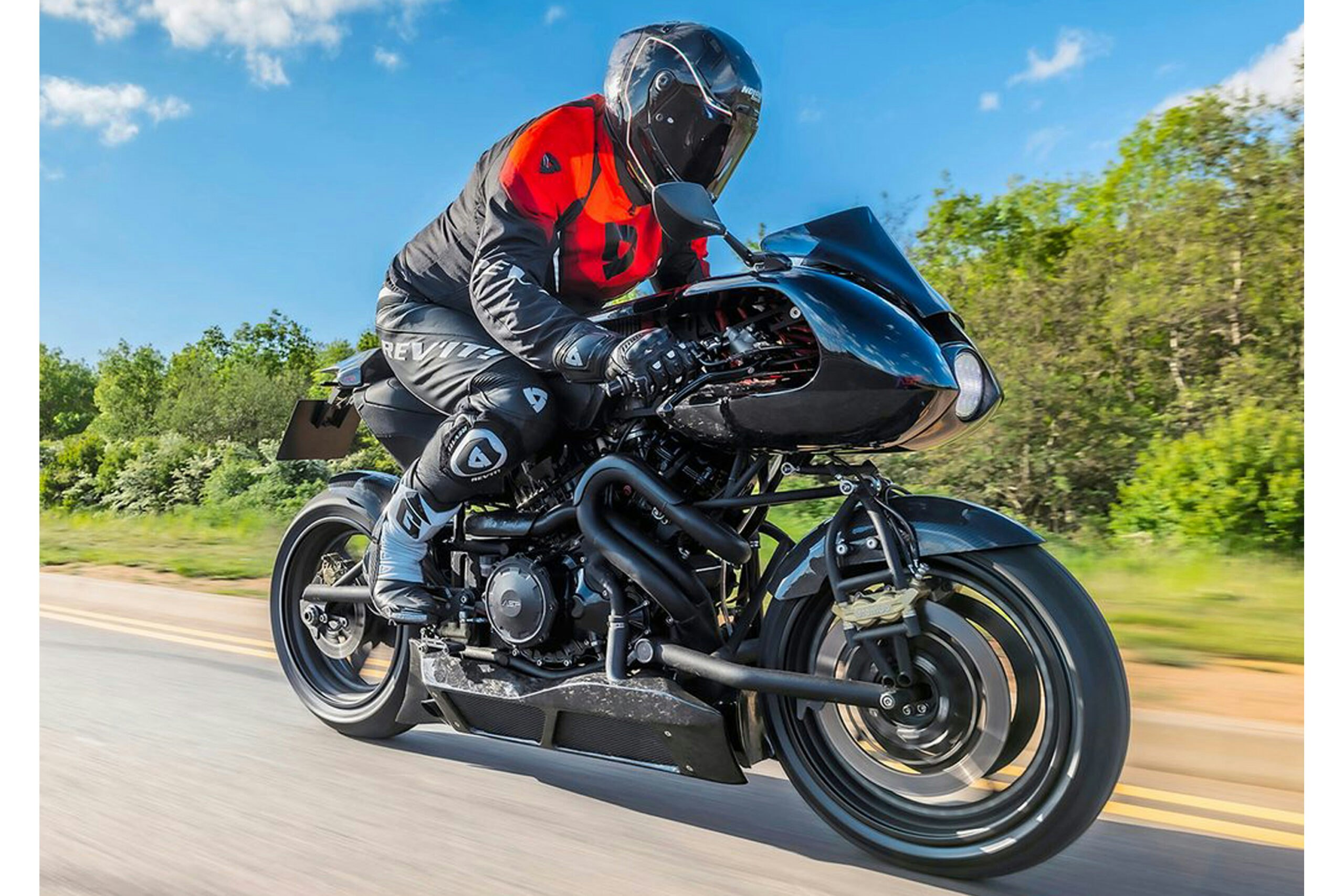
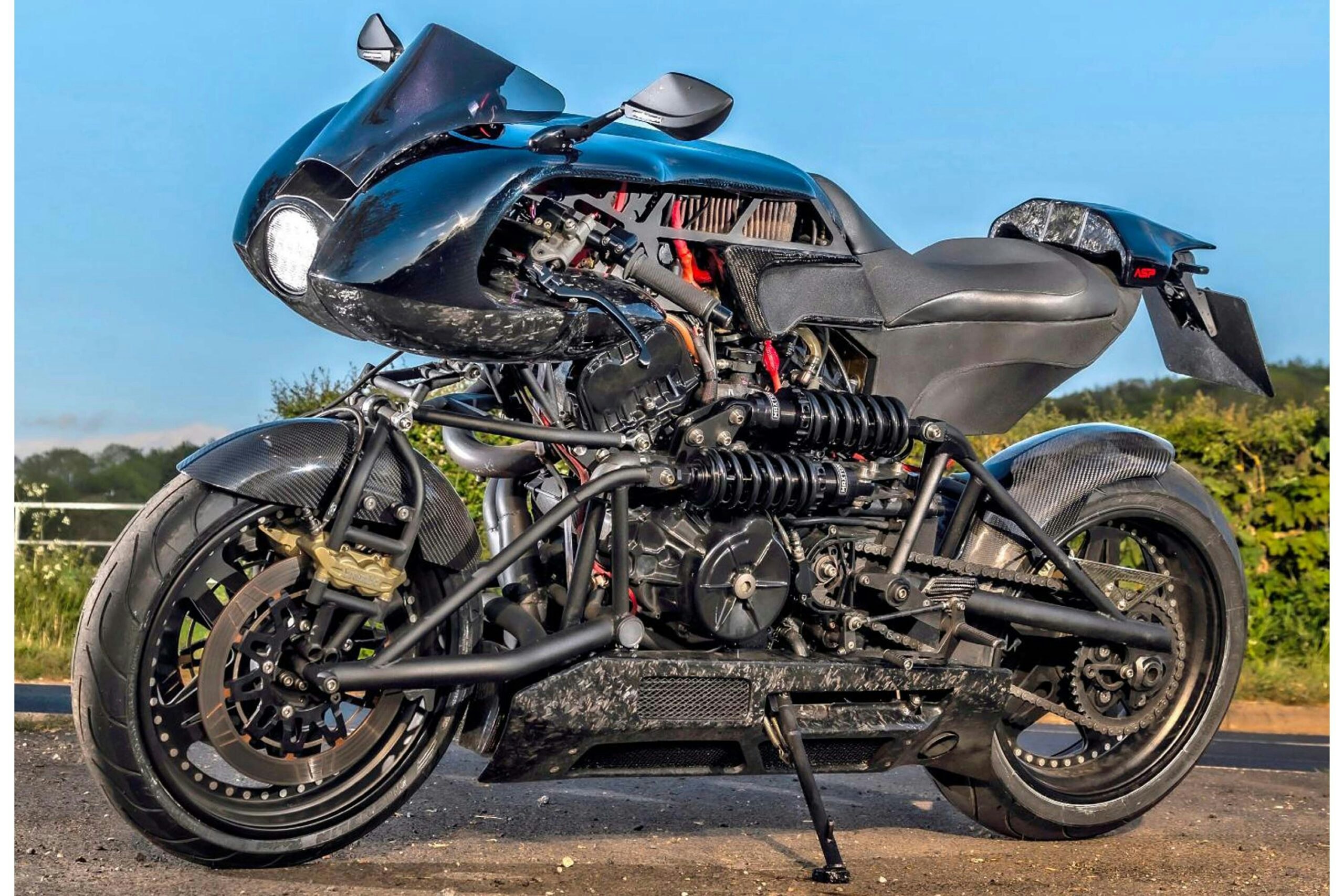
What’s most impressive (and bonkers) about the ASP4 is not the steering set-up, Andy’s unique packaging solutions, or its bullish styling – all of which we’ll come to – but the numbers. This is a 1000cc sportsbike that runs a tighter wheelbase than an RGV250. At 1360mm between spindles it’s 15mm shorter than said Suzuki, and 55mm more compact and 18kg lighter than the Aprilia Falco to which it owes its engine. Oh, and the rake and trail equate to a ludicrous 15°/80mm; it makes an RGV’s 25°/94mm look positively lethargic. Figures like those confirm this is as far from conventional litre sportsbike territory as it’s possible to be, while still maintaining the aforementioned capacity and razor-sharp intent.
Thus far only Andy has ridden the ASP4 – including a trip to the TT minus bodywork, to the bemusement of those who saw it parked up around the Island. ‘Some people don’t know what to make of it,’ he says. ‘Last year I nipped out for a ride to Matlock. When I got home someone had posted a pic of it on the internet with the caption, “Batman: 9 missed calls…”’
Gotham’s hero can wait his turn, however. Today it’s mine. But given how different the ASP4 is to anything else I’ve ever ridden, I’m not sure what to expect. Andy guides me through the start-up process – it’s a keyless ignition – then grins knowingly as I press the starter and fire the barely silenced motor into life. ‘I’m keen to know what you think.’ Me too.
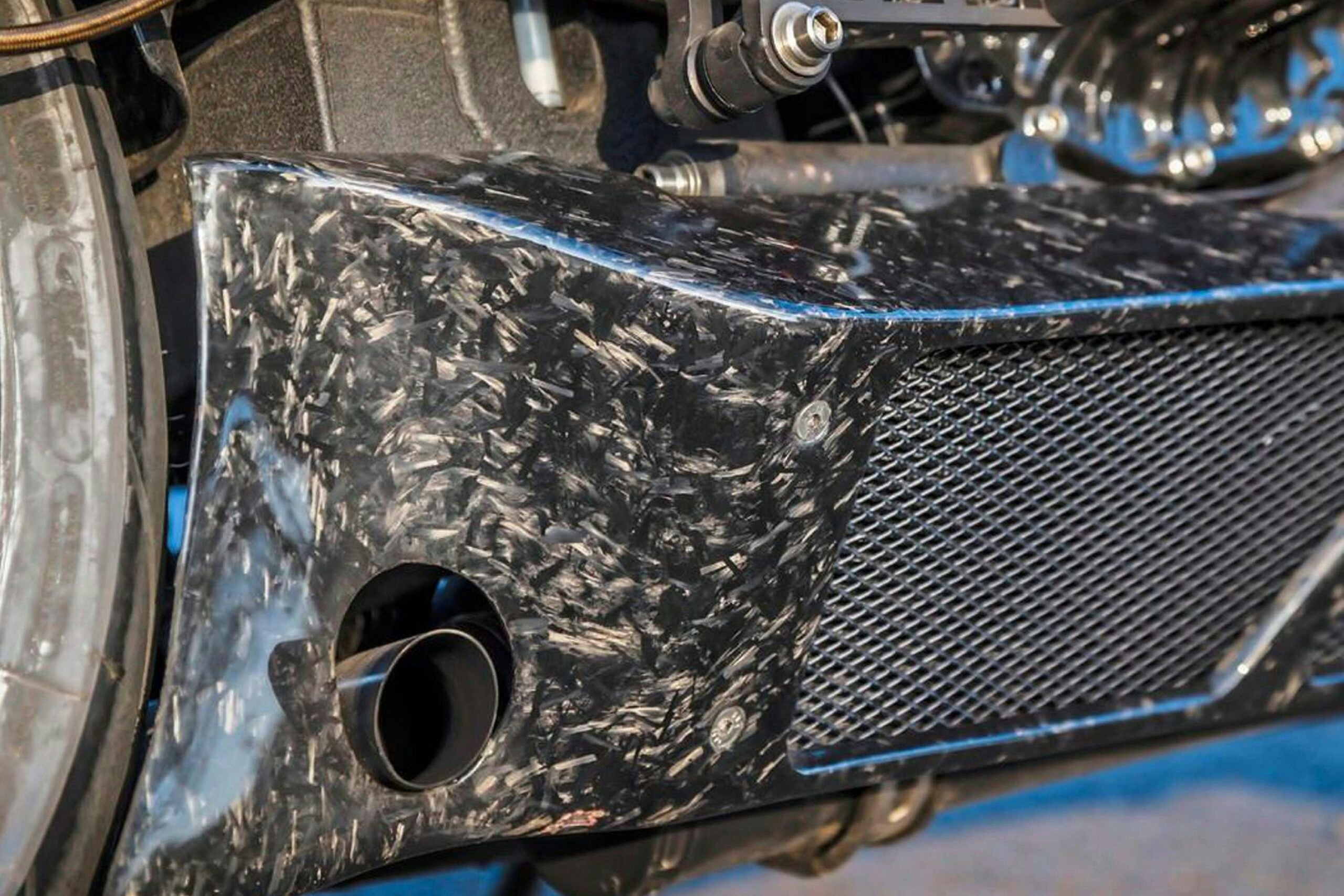
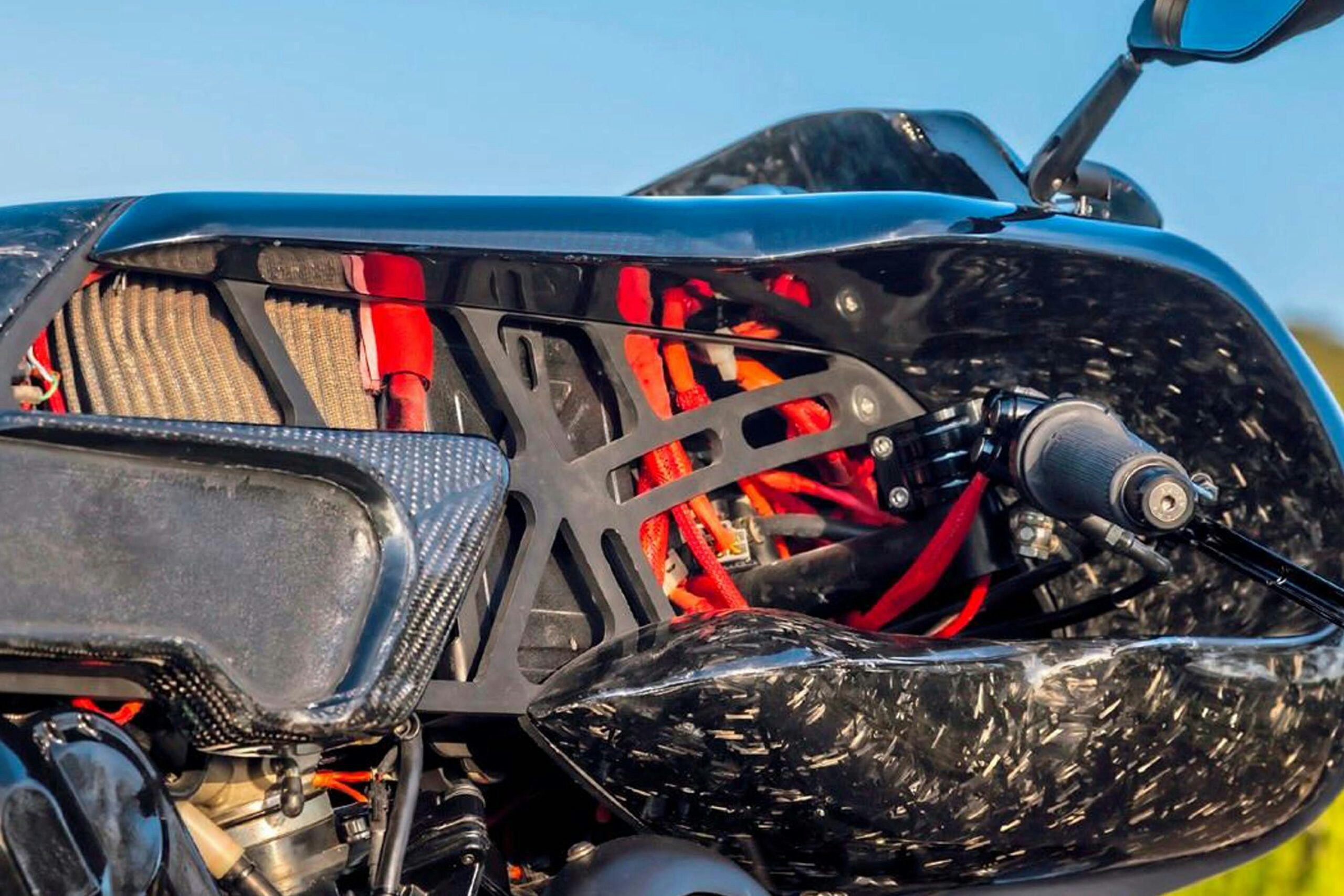
Perched on the 850mm high seat, I’m greeted by a unique view: a sculpted carbon fibre cover that stretches from the front of the seat to the headlamp up front, flaring out when level with the bars, then wrapping seamlessly around the whole upper front end. There’s no fuel filler (the 17-litre aluminium tank sits under the seat to aid centralised mass), yokes or headstock between me and the single Koso tacho and mini-screen. Just clean, beautifully finished bodywork; the outer thirds being conventional lacquered weave, with ‘camo’-look carbon fibre detailing the middle section. It’s the kind of luxurious finish you’d expect of a high-end production car.
‘Hardest part of the build, that,’ Andy tells me as I run an admiring hand over what would be the tank on most other bikes. ‘I’d never worked with carbon fibre before, so I had to learn the whole process from scratch: moulds, textures, finishes, the lot.’
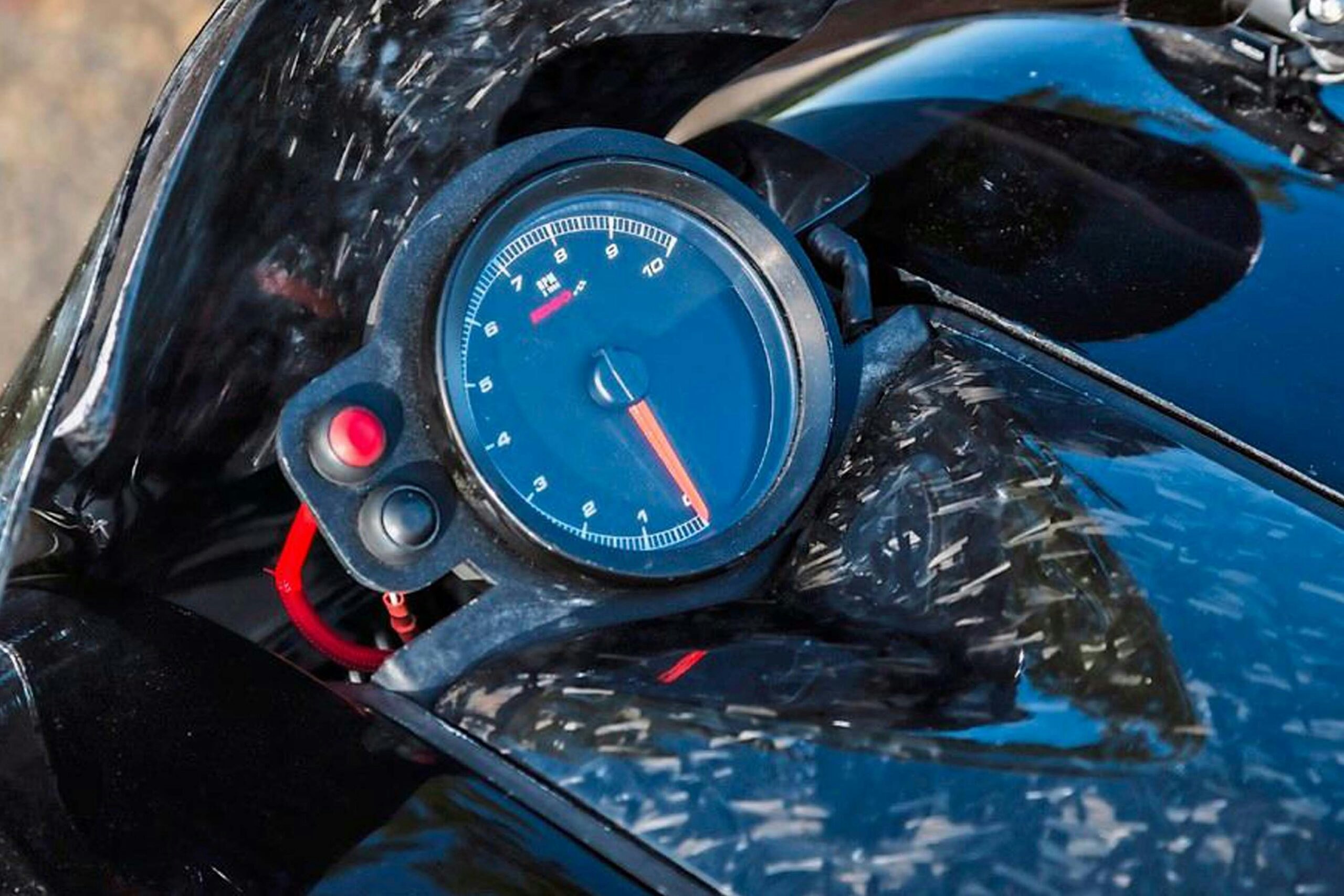
My first few miles are tentative. The forkless front end feels very different to what I’m used to; my commands through the bars to the front wheel generate a sensation alien to my previous 45 years of riding experience. More direct, more sensitive, yet something I’m keen to explore.
Andy leads the way on my Honda CB1000 Hornet SP, away from the urban sprawl and dual carriageway near his midlands home, onto faster, quieter country routes. Before we set off he told me we’d be heading for a stretch of road he refers to as his ‘test track’; several miles of bumpy, bendy and undulating tarmac that’d put any chassis to the test.
I know instinctively when we’re there. Ahead Andy’s fighting the Hornet as it bucks and protests over the uneven surface. Despite its Öhlins shock, the Honda’s working him hard. I’m gaining ground, however, throttle pinned, as the ASP4 simply glides over the same terrain. This shouldn’t be possible on a bigcapacity twin with thumping acceleration and a wheelbase shorter than a race rep 250. But it’s encouraging me to push harder still. The key to this bike, as I’m discovering in real time, is the faster you go, the better it feels. Ten miles into our ride, the initial quirkiness of the steering has melted away.
‘A 1000cc sportsbike with a tighter wheelbase than an RGV250’
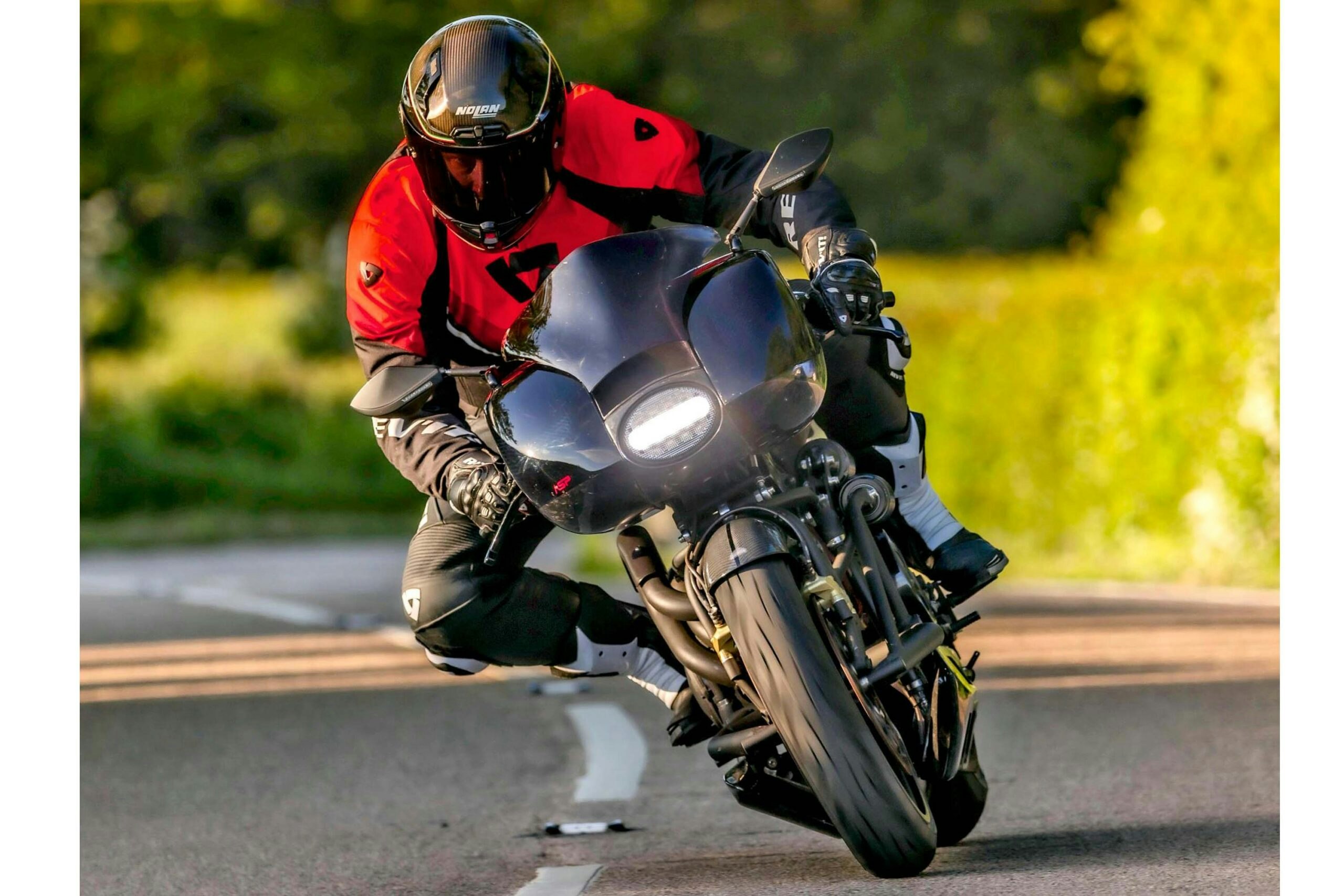
I’d expected it to feel vague, even disconnected at its front end. Bimota’s Tesi was notorious for such behaviour. ‘The Bimota’s pointlessly overcomplicated,’ says Andy, ‘with its steering forces going through several different planes between bars and wheel. No wonder they lacked feel. And unlike a conventional bike, mine doesn’t have 15kg of forks and yokes hanging out the front end, kicking back over bumps.’
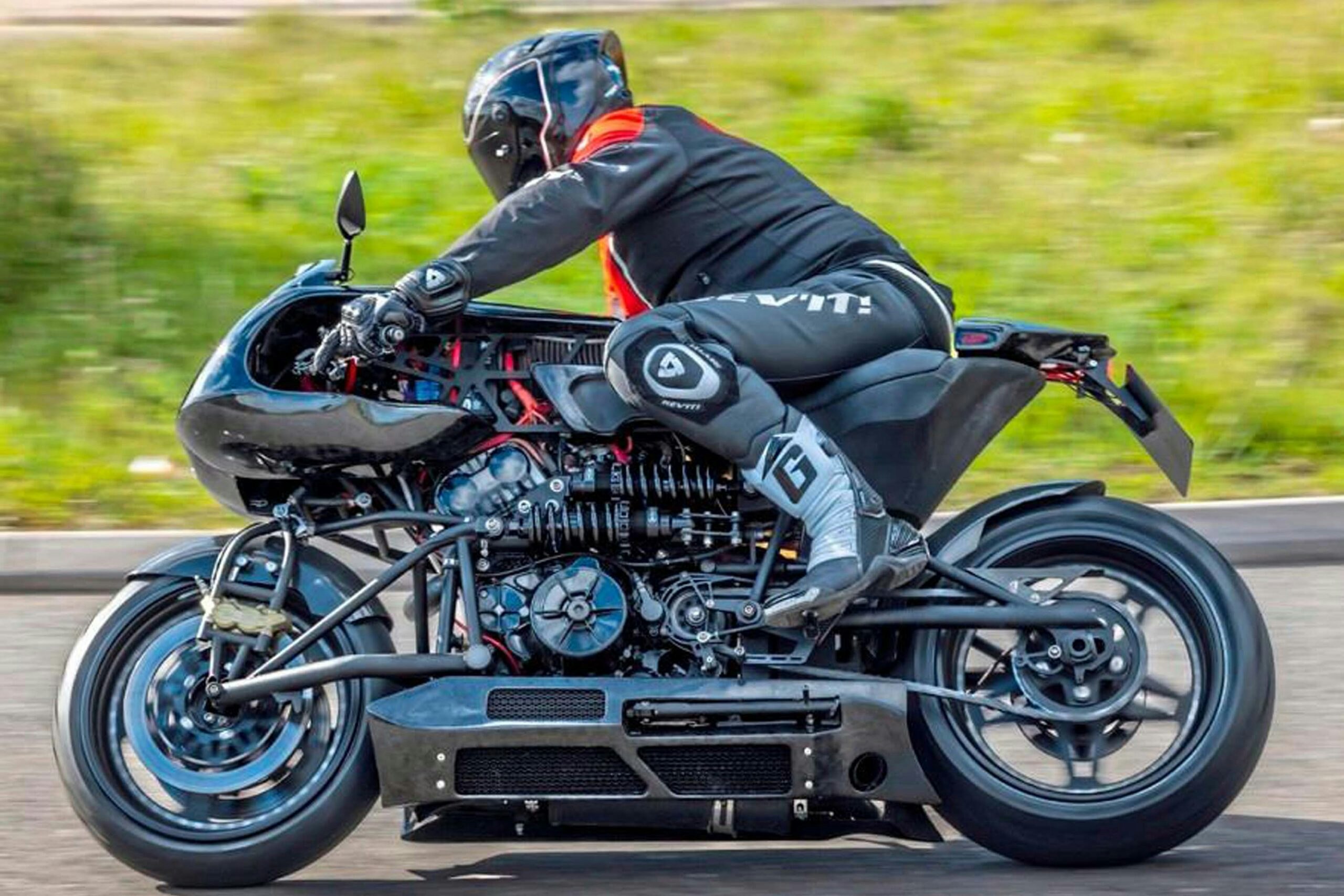
Unlike a Tesi, Andy’s bike is a genuine hub-centre set-up. The bars attach to a modified mountain bike steering stem that connects directly to a ‘collapsible’ linkage, and that in turn to the steering cage. Steering forces are interpreted via a spherical bearing inside a drum that’s effectively the front spindle. Every element was designed and made by Andy.
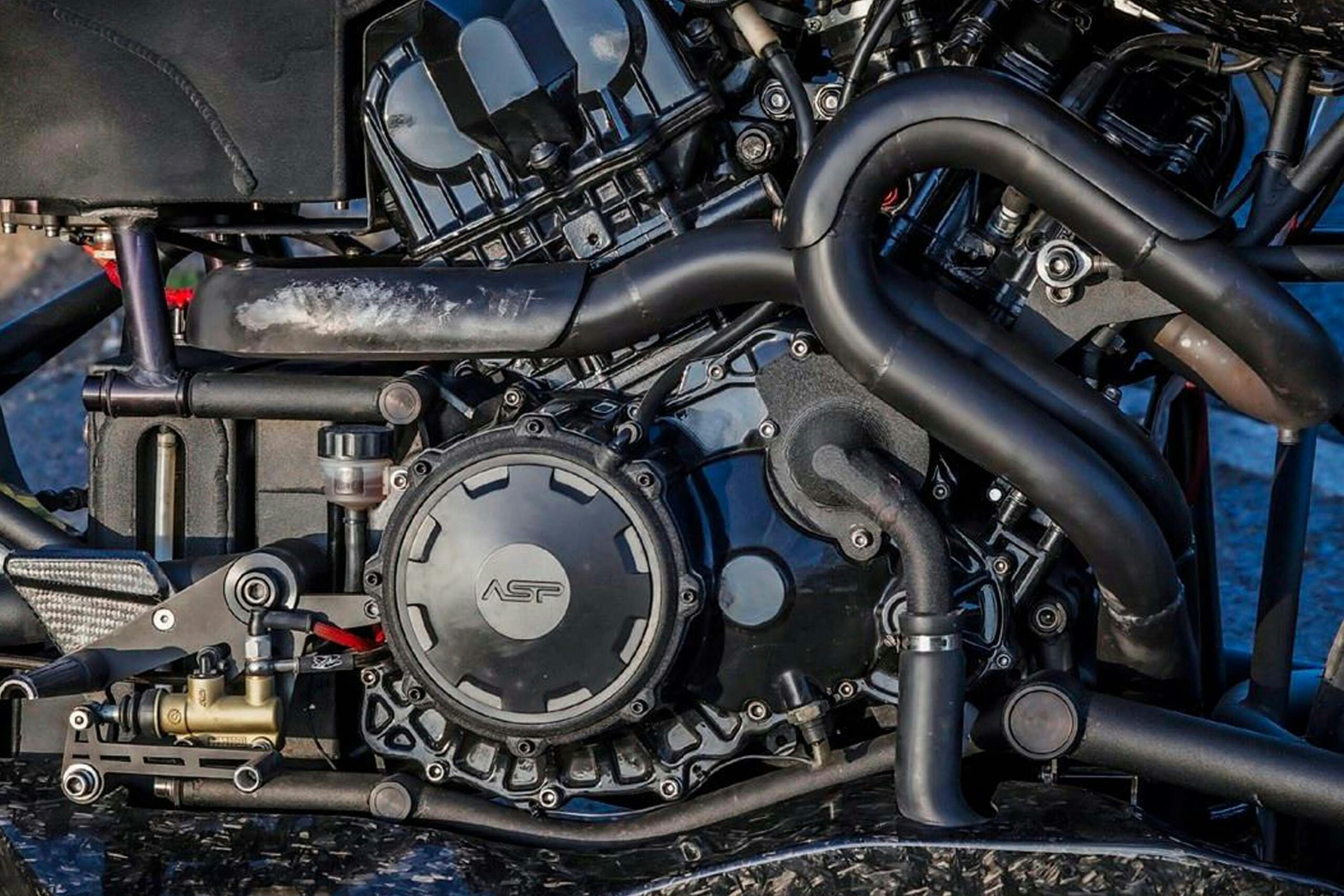
The chassis is an exercise in minimalism. T45 steel tubing makes up the engine cradle and front and rear swingarms, while machined plates form an upper spine to which the bodywork and surrounding componentry attaches. A Mercedes-Benz E300 K&N filter is encased between the plates (‘It was the biggest I could find’).
Indeed, from both a visual and mechanical point of view, the bike’s middle section is busiest of all.
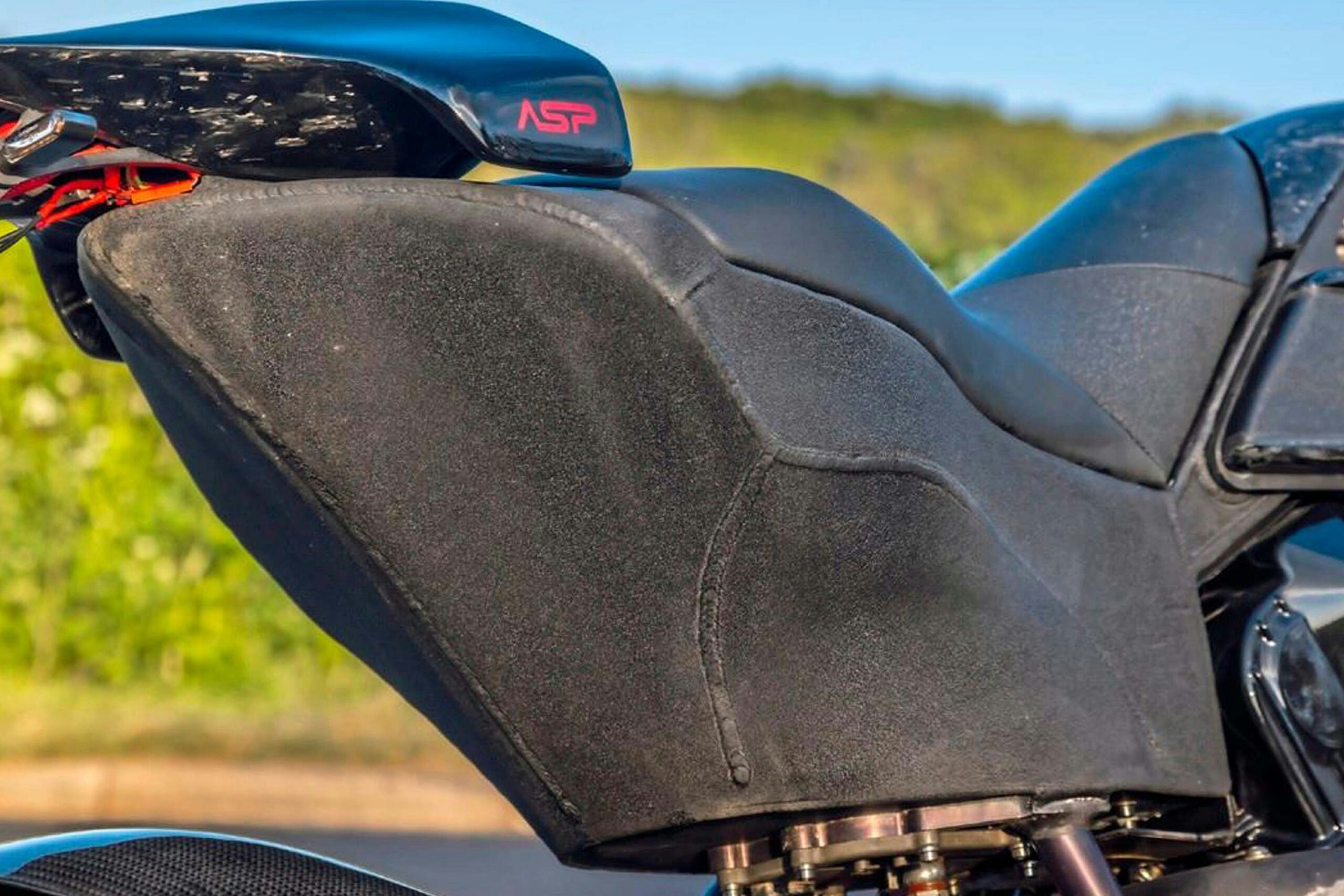
‘The key to this bike has been centralising the mass,’ Andy explains. ‘At its centre is the crank – it’s longitudinally central in the bike. Even the rear caliper is deliberately mounted on the top of the disc to get it nearer to the roll axis. The best way to think about mass centralisation is a bar bell with 10kg on each end. It’s easier to control when those weights are nearer to the centre. Simple stuff.’
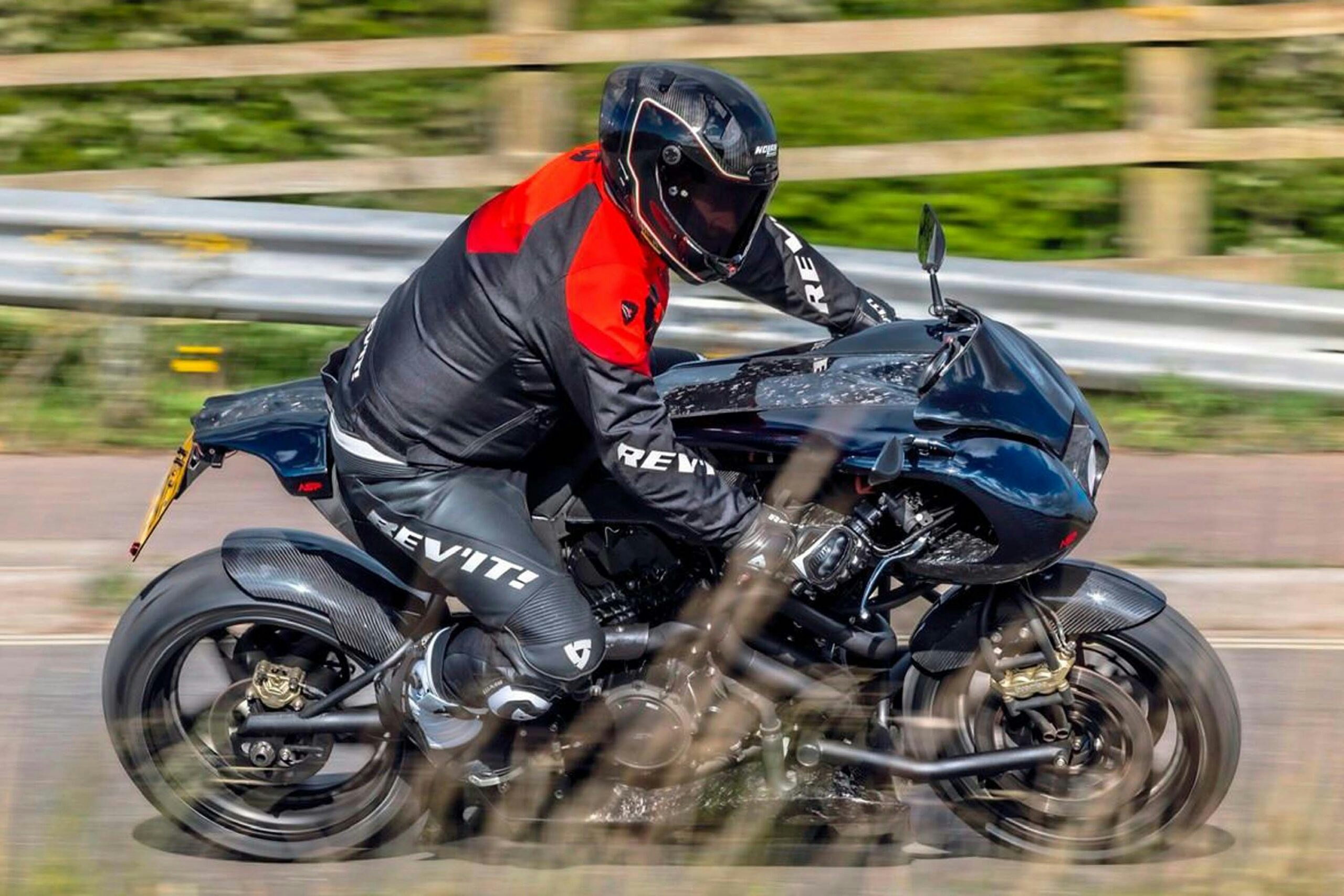
It works, too. Not only is the ASP4 stoically stable over bumps that’d have most sportsbikes breaking into a twitchy head shake, it laps up corners like a race rep half its capacity. The steering is deliciously light thanks to its lack of weighty componentry so it’ll trace any line you plot as well as adjust course mid-turn without complaint. There’s a sensation of front end dive under braking, too. Not as much as with conventional forks, but enough to give the front end a familiar feel.
Quality suspension plays a large part in the bike’s remarkable composure. Twin Maxton NR4 shocks absorb forces from both ends. ‘They’re fully adjustable without having external gas bottles, which I didn’t want,’ says Andy. ‘You’ll notice horizontal lines are something of a theme in the styling. Mounting the shocks on that plane mirrors that look as well as keeping mass central and allowing the rest of the packaging to be as tight as possible.I can’t praise Richard at Maxton highly enough. I’ve not even needed to adjust damping since fitting them.’
After riding the ASP4, I’m keen to share my thoughts. All I’d change is the one thing Andy didn’t design and build: the motor. Not for a different configuration – a tightly angled V-twin like this Aprilia unit keeps the whole thing slim. But for something more powerful, like an RSV Mille lump. It’d slot straight in. The chassis could easily handle an extra 25-30bhp.
hat Andy has created through almost four decades of evolution, dogged determination and sheer bloodymindedness is remarkable. Not only does it perform where internationally recognised marques like Bimota failed, but the way it rides and hangs together are on par – if not better – than many contemporary machines from large manufacturers. Not bad for something designed ‘on the sofa with several bottles of red…’
SPECIFICATIONS
Engine 998cc 8v DOHC 60° V-twin
Power 118bhp @ 8250rpm
Torque 71lb·ft @ 7000rpm
Frame T45 tubular steel semi-cradle
Rake/trail 15°/80mm
Wheelbase 1360mm
Weight 172kg (dry)
Seat height 850mm
Tank size 17 litres
Economy 50mpg (est)
Electronics none
The original ASP
» It all started way back in 1991 with the ASP, a project bike for this very mag, and the reimagining of a crashed FZR1000 EXUP. Andy enthusiastically cut apart the Yamaha’s Deltabox frame, removing the steering head and top portion of both beams, then equipping the front end with his own self-designed hub-centre steering componentry.
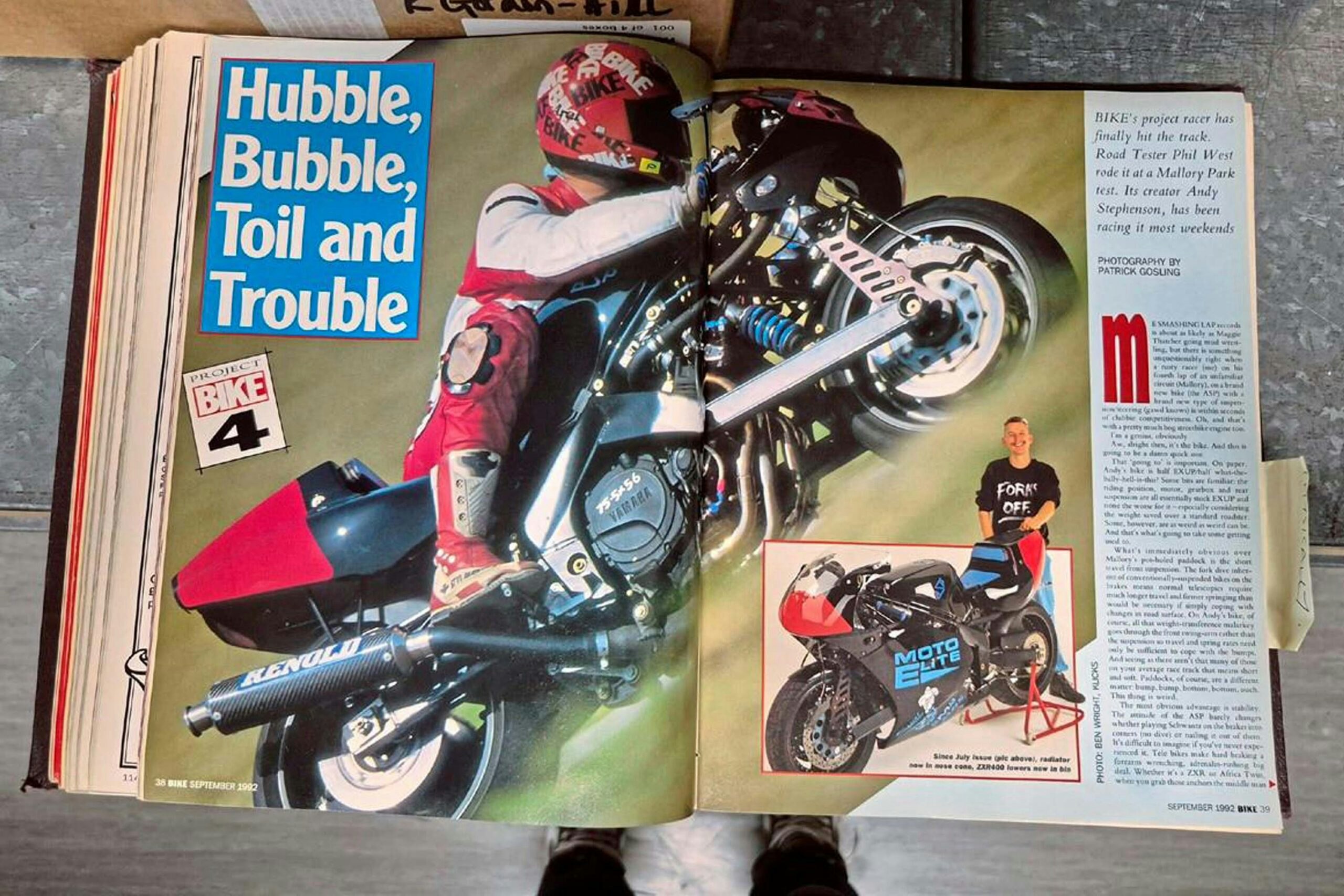
Bike’s road tester Phil West sampled the ASP around Mallory Park, concluding: ‘When you remember Bimota has spent the best part of 10 years and millions of Lire developing the Tesi, while Andy spent about five grand and eight months, mostly by himself, it’s not just good, it’s disgustingly, outrageously, embarrassingly good.’
Being the first of its kind, the ASP required a fair amount of setting up and development work to tease out its best – reducing trail, experimenting with ride height, and simply getting to grips with the immense potential of then revolutionary six-pot front brakes as well as the bike’s less-kinetic reaction to scrubbing off speed.
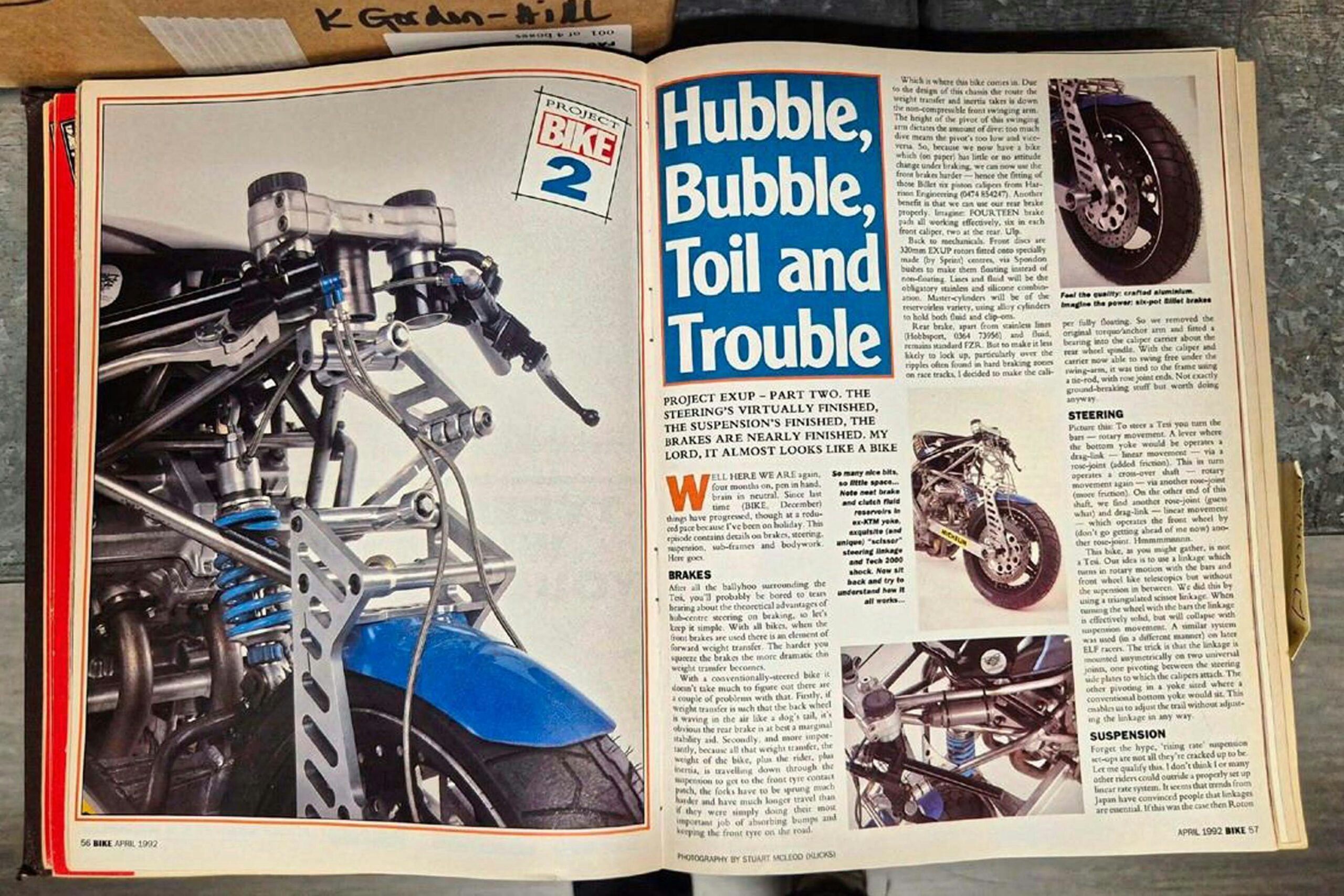
‘Up to now it’s been quite simple to sort the chassis,’ remarked Andy back in 1992 of his finished ASP, before he started racing it. ‘Now I’ve got to bring myself up to the standard of the bike, and that cannot be done by tweaking my knob. Worth a try though.’